

Digital literacy in the workplace is going up the priority list for digital workplace teams as recognition grows of its importance to adoption, productivity and wellbeing. But if you’re wondering where to start with digital skills in your organisation in 2020, here are some top tips and resources from around the industry. There’s advice and inspiration from Brad Grissom, Sam Marshall, Emma Weston, Lee Bryant, Tracy Van der Schiff, Steve Bynghall, Chris Tubb and myself.
Why should you care about digital skills at work?
In 2019, Lloyds Bank UK Consumer Digital Index laid down the gauntlet to organisations to up-their-game on workforce digital skills. It’s a challenge that applies not only to UK companies, but to any organisation wanting to realise its digital ambitions. I highlight some of their key findings for digital workplace practitioners in my post ‘Half the workforce isn’t ready for the digital workplace’.
This and other research shows unequivocally that many workers are struggling with digital skills and that organisations are often falling short in helping them to learn – the impact on digital workplace adoption is significant with many lacking the capabilities to make the most of the new technologies being rolled out.
Defining digital literacy in the workplace
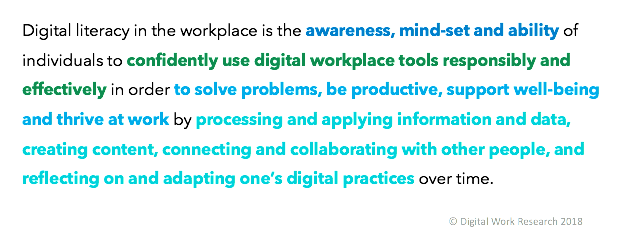
In a post that seems to have chimed with many practitioners, ‘What do we mean when we talk about digital literacy?’, I suggested a definition of digital literacy in the workplace. I emphasise that we need to think beyond just technical skills to include awareness, attitudes and a broad set of abilities to use the digital workplace both competently and confidently. These include elements such as information literacy, creating content, connecting and collaborating with others, and looking after our digital wellbeing.
It’s important to use the term (e.g. digital literacy, digital competence) that resonates inside your organisation. Brad Grissom has a compelling suggestion…
Gaining digital mastery in the digital workplace
Brad challenges us to go beyond notions of digital literacy, talking instead about ‘digital proficiency’ in his post ‘Digital Proficiency: Literacy, Fluency and Mastery’. He defines this term as ’the measure of capacity to use digital technologies to one’s benefit’ – we may start by just gaining literacy, but we can then move on through fluency to mastery. While fluency implies a level of ease using the digital workplace, Brad shows us that digital mastery is the really exciting goal, where people can push the limits of technologies to get the most out of them.
A framework for understanding and measuring digital literacy
However you define digital literacy, it’s important to have some kind of framework to understand the array of skills the workforce may need, and use as a basis for measurement. I published a free, in-depth guide to my own framework ’The Digital Workplace Skills Framework: Ensuring the workforce is ready to work digitally’ for practitioners to use for this very purpose. And in ’So you’re transforming the digital workplace. But do you know your organisation’s Digital IQ?’ I highlight why measurement matters: for gaining actionable insights on the workforce’s digital readiness, focusing digital skills investment, and tracking progress.

Digital skills are at the heart of the learning organisation
Lee Bryant writes in depth about the role of digital skills in the learning organisation in his post ‘Bridging the Digital Skills Gap in the Digital Workplace’. He highlights the importance of shared responsibility for digital skills between organisations and employees, and the need to weave digital learning into day-to-day work rather than outmoded spoon-feeding via traditional training methods. A key point from Lee is the potential of digitally skilful leaders at the helm of digital transformation – and the lag that can come from leadership with poor digital skills and awareness.
The challenge to traditional notions of how to raise digital skills is taken up by others in our industry, underlining the need to be creative in our approaches…
Learning digital skills through play
Sam Marshall reminds us of the importance of play to learning digital skills in his article ‘Why play is important for digital literacy’. While traditional learning has its place, Sam emphasises the need for people to experiment with technology, make mistakes and be (temporarily) inefficient while they try new things – all in a safe space, like a sandpit site. It’s a timely reminder that ‘users’ are people not automatons. Sam again emphasises this human aspect by including digital emotional intelligence as one of ‘Seven digital skills everyone should have‘ – it’s an element that’s often missing in the growing melee of digital communication channels and collaboration places.
As well as playing and experimenting, we also need other people who can help us gain confidence and learn new things.
Unlocking the power of workplace digital champions
Emma Weston waves the flag for the power of champions to raise digital skills inside organisations in her post ‘Knowing your onions – why workforce Digital Champs make Learning at Work zingy’. Like Sam, Emma challenges traditional training notions and highlights the power of a network of digital champions to cascade digital skills throughout the organisation ‘from Boardroom to Boiler Room’. And her post includes a zingy infographic from Digital Unite:

Launch a digital literacy campaign to support Office 365
Tracy Van der Schiff has lots of good, nitty gritty advice on improving digital skills, particularly in relation to using Office 365 in the workplace. In her post ‘Office 365 Supports Digital Literacy Skills’ she offers advice on rolling out a digital literacy campaign to support employees with Office 365 apps ‘instead of just throwing new tech at them’. One top tip from Tracy is to ensure this is a cross-functional initiative involving HR, training, change management as well as IT. She also counters the all-too-common view that now O365 has arrived no training is required (!!) and gives a timely reminder that ‘inefficient users are costing companies millions and lead to unhappy workplaces’. Her post includes a graphic mapping digital skills to O365 apps:

Don’t forget skills for the digital workplace team
So far we’ve considered digital skills for the workforce as a whole. Chris Tubb and Steve Bynghall in their detailed ’Spark Trajectory skills matrix’ focus in on the skills that are needed for the digital workplace team specifically. It includes core intranet and digital workplace management skills as well as UX design and management of content and communication, tech and IT, and collaboration. Using a maturity model that runs from apprentice, through practitioner, to master – the matrix provides a way of measuring and evolving the team’s skills over time.
In many ways we might see digital skills as starting with the digital workplace (and related) teams and rippling out to the rest of the organisation. (That’s the way Cancer Research UK are viewing it, with their ‘dandelion model’ to devolve digital skills across the organisation).
Hopefully this is a round-up of advice that you’ll find useful inside your organisation. What did I miss? Have you come across a top resource for raising the Digital IQ of the workforce?
Originally published on Linked In.