

As I’ve been getting out and about and talking to digital workplace teams about The Digital Workplace Skills Framework and The Digital Workforce Skills Assessment, it’s got me thinking about how to define digital literacy in the workplace. It’s an important starting point for organisations thinking about improving the digital skills of the workforce. As with other key terms – not least “digital workplace”! – the definition will vary depending on the organisation and what it’s trying to achieve digitally.
There are lots of definitions of digital literacy around. They range from a fairly narrow view of technical skills through to much broader depictions that acknowledge the wide range of ideas, social practices, attitudes and abilities needed to live and thrive in the digital age. If you’ve read any of my other ponderings, you’ll know I’m an advocate of the latter view. There are some good, broad definitions out there but they tend to relate to digital literacy in a more generally sense, or within an education or citizen context. As my Digital Workplace Skills Framework shows, we need to apply a very specific lens in order to focus on the skills needed to work digitally.
So here’s my digital workplace skills definition in progress. I’d welcome feedback and thoughts as I evolve this…
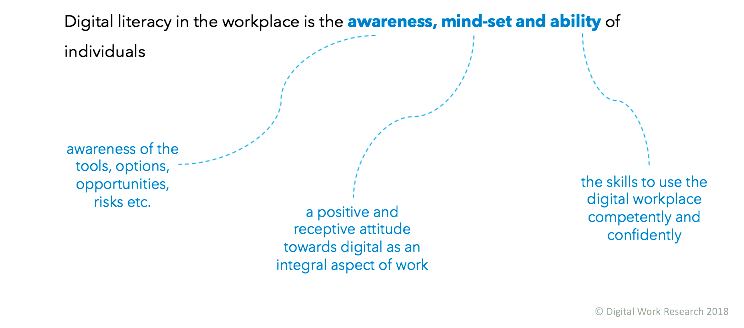
It starts out by focusing attention on the fact that to successfully work in the digital workplace, we need more than just technical skills – we need to foster awareness, attitudes, and a broad set of abilities:
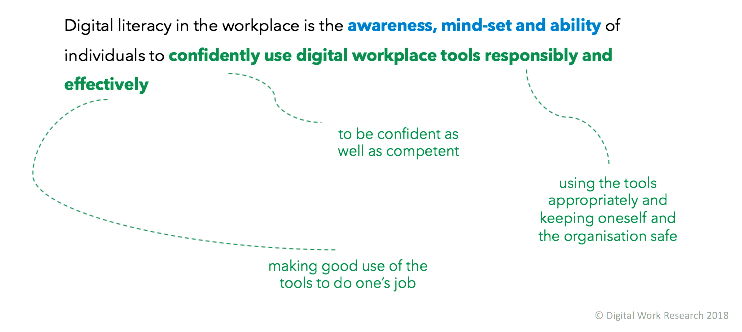
This foundation sets individuals up to not just use digital workplace tools, but do so with a sense of confidence and fluency as well as – critically! – understanding how to do so in a responsible manner that keeps the individual and organisation safe:
Why do all this good stuff? Well, to get work done, solve all kinds and shapes of problems we encounter as we do so, stay well while we work digitally, and generally flourish in the digital world of work:

How do we do all this? Well, that’s where the Digital Workplace Skills Framework comes in – in other words the broad set of skills we need to use the tools, be information savvy (whether we’re creating or consuming content), collaborate and staying connected, and apply a critical eye to all of these practices so that we keep learning:

Here’s a reminder of the framework:

It’s a balancing act between to get a definition that is sufficiently all-encompassing without becoming convoluted and wordy. Let me know how you think I did!
How are you defining digital literacy in your organisation? Does this definition resonate with you? What would you change or how would you develop it?
In coming up with my definition I referenced a range of existing digital literacy definitions including: Lankshear & Knobel (2008), NMC (2015), Lanham (1995), Gilster (1997), Martin (2006), Belshaw (2011), Eshet (2011), Hague & Payton (2010), Calvani, Fini & Ranieri (2009).
Originally published on Linked In.
Featured image by mohamed Hassan from Pixabay.