

Over the past year, I’ve been spending a lot of time revisiting and reworking how I use digital skills frameworks in client work. Most recently this has been driven by the release of DigComp 3.0, which represents a significant evolution of the European Digital Competence Framework, particularly in its stronger emphasis on AI, sustainability, and digital wellbeing. But it’s also been driven by something more practical: the ongoing challenge of making digital skills frameworks useful in real workplace contexts.
DigComp 3.0 is, without question, a comprehensive and well-considered framework. It reflects over a decade of development and provides a robust, policy-aligned view of what digital competence means today. In recent years it has moved well beyond basic skills, incorporating data literacy, AI awareness, safety, and aspects of digital wellbeing. For many organisations, this breadth and credibility are hugely valuable.
However, as with earlier versions of DigComp, I continue to see a gap between framework-level definitions of competence and the lived reality of digital work. This is where interpretation becomes critical — and where DWR’s Digital Workplace Skills Framework and approach still plays an important role.
From “what” to “how”
At its core, DigComp answers the question: what digital competences matter? DWR, by contrast, has always been more concerned with how those competences show up in everyday work.
In practice, organisations rarely struggle because people don’t know what tools exist or what skills are theoretically required. They struggle because:
- people lack confidence to apply skills consistently,
- digital work is shaped by habits, norms, and organisational culture,
- new tools (especially AI) change how work is done, not just what work is done,
- and wellbeing, overload, and cognitive strain quietly undermine adoption.
DigComp 3.0 acknowledges many of these issues — particularly through its expanded treatment of wellbeing and responsibility — but it still operates at a level of abstraction that requires translation before it can be assessed meaningfully or linked to learning and change initiatives.
Blending the best of DigComp and DWR
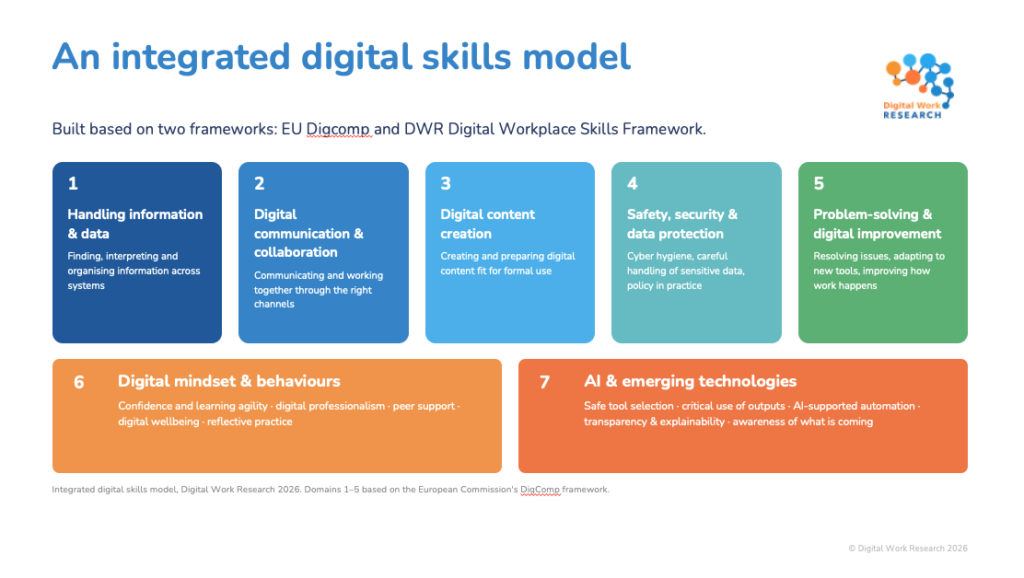
In my current client work, I’m increasingly using DigComp 3.0 as a reference backbone, while retaining the DWR framework as the interpretation and application layer.
The DWR approach remains important because it:
- treats digital competence as behavioural as well as technical,
- explicitly considers confidence, adaptability, and judgement,
- recognises that adoption is shaped by organisational context, not just individual skill,
- focuses on sustainability of digital work, not just capability in isolation.
While DigComp 3.0 includes digital wellbeing within its safety area, DWR goes further in operationalising what wellbeing actually means in digital workplaces: managing attention, coping with change, setting boundaries, and developing sustainable ways of working with technology over time. These are not abstract concerns, they are some of the strongest predictors of whether digital initiatives succeed or fail.
A pragmatic integration in practice
What this has led to, in practice, is a hybrid approach in which:
- DigComp 3.0 informs the overall competence landscape and provides external credibility and consistency.
- DWR shapes how competences are interpreted, assessed, and developed in workplace contexts.
- A suite of tools I’ve developed including competence catalogues, role-competency mappings, and assessments are designed to bridge the gap between frameworks and day-to-day work.
This integration allows organisations to benefit from the strengths of DigComp without being overwhelmed by its scale, and without losing sight of the behavioural and cultural factors that ultimately determine digital effectiveness.
Frameworks don’t do the work — people do
One of the risks with any comprehensive framework is assuming that adoption will naturally follow definition. In reality, frameworks don’t change organisations; people do — and they do so through practice, reflection, and support.
As digital technologies continue to evolve rapidly, particularly with the growing presence of AI in everyday tools, the challenge is no longer simply keeping frameworks up to date. It’s ensuring they remain interpretable, assessable, and usable in the messy reality of digital work.
DigComp 3.0 is an important step forward. But interpretation, context, and behaviour still matter — and that’s where I continue to see the value of the Digital Work Research perspective in helping organisations build not just digital skills, but sustainable digital capability.